Pragmatic Climate Control Design
- 3 min read
I keep coming back to the same frustration when looking at car interiors: most of the good ideas already exist, but rarely in the same car.
One manufacturer gets the physical controls right. Another has a useful shortcut. A third has a clever interaction that nobody else seems to adopt.
Why not take the good parts and combine them intelligently?
This is the same thinking behind my Pragmatic Steering Wheel Design. I am not trying to reinvent the dashboard. I want a climate-control panel that is tactile, predictable and usable without looking away from the road.
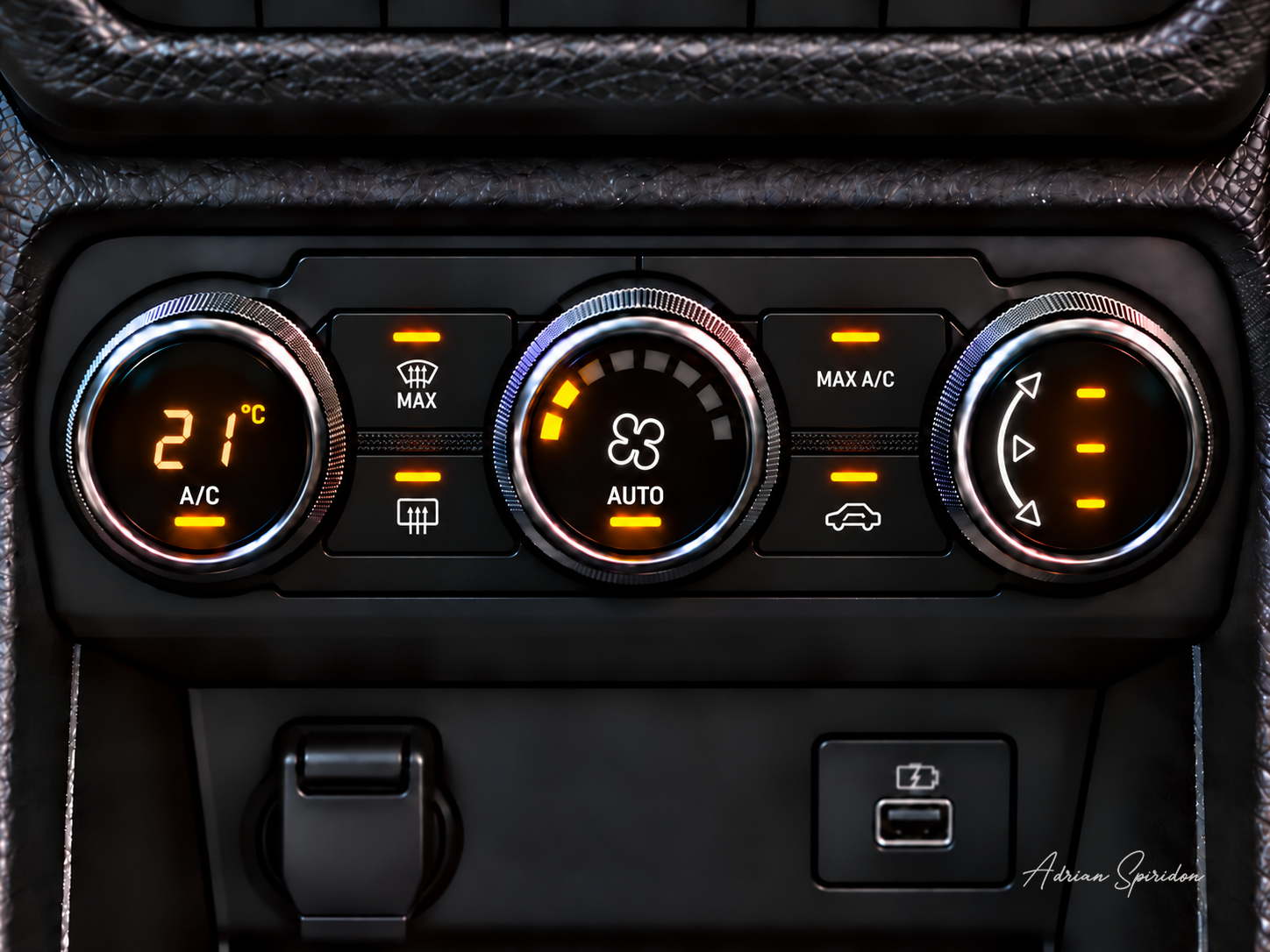
Take the good parts
Start with three physical knobs. The three-knob format has been around for decades, and Renault/Dacia still demonstrate how compact it can be. Large rotary controls give the driver a physical reference point without requiring visual attention.
The left knob adjusts temperature; pressing it toggles ordinary A/C. The middle knob controls the blower; pressing it engages AUTO. The right knob controls where the air goes. Three knobs, three clear responsibilities.
Keep dedicated shortcuts for actions that should be immediate. Ford’s MAX A/C is a good example: sometimes I do not want to negotiate with temperature and fan settings; I want maximum cooling now. So there are four direct buttons between the knobs: MAX front demisting, MAX A/C, rear-window defrost and recirculation.
Reuse the fan knob for AUTO intensity. In manual operation, turning the knob changes blower speed. In AUTO, the same rotation selects between three automatic intensity profiles: gentle, normal and strong. The climate system still regulates the fan automatically; I am only telling it how aggressively to work. There is no reason to add another control for this.
Borrow the spring-return idea from modern electronic gear selectors. Airflow direction does not need an indexed knob that cycles through predetermined combinations. A momentary turn left toggles windscreen airflow; a press toggles face-level airflow; a momentary turn right toggles footwell airflow. The knob returns to its neutral position after each turn, while the selected outlets remain active. Each direction is independent, and the three amber indicators show the current state.
If I want windscreen and feet but not face, I should be able to request exactly that. Not cycle through combinations until the car eventually arrives at the one I wanted.
Even the smaller details follow the same principle. The physical buttons are separated by a tactile ridge, making them easier to distinguish without looking. The large knobs themselves serve as tactile landmarks.
None of these ideas is particularly revolutionary. That’s precisely the point. Good solutions already exist; the challenge is to recognize them and combine them into something coherent, intuitive, and usable without taking your eyes off the road.